SPECIALIST JOINERY
Space and money are usually the limiting factors in the design of a model
railway. Unfortunately we cannot help you with the money side of things, however
specialist joinery can make more of the space you have. Professional Layout
Services have been asked to make many items of specialist joinery with the two
most common requests being spirals and traversers with other joinery including
high level track beds and gradients,
carrier frames, diorama boards, back scene boards, folding baseboards, control panel
draws and lifting sections. All are featured on this page.
SPIRALS
Spirals
are the most efficient space saving way of forming gradients where a large climb
or fall in the track level is required. Often used to access hidden storage
sidings beneath the normal layout level, or as a way of making a train disappear
and then emerge in a different place, on a different level and usually going in
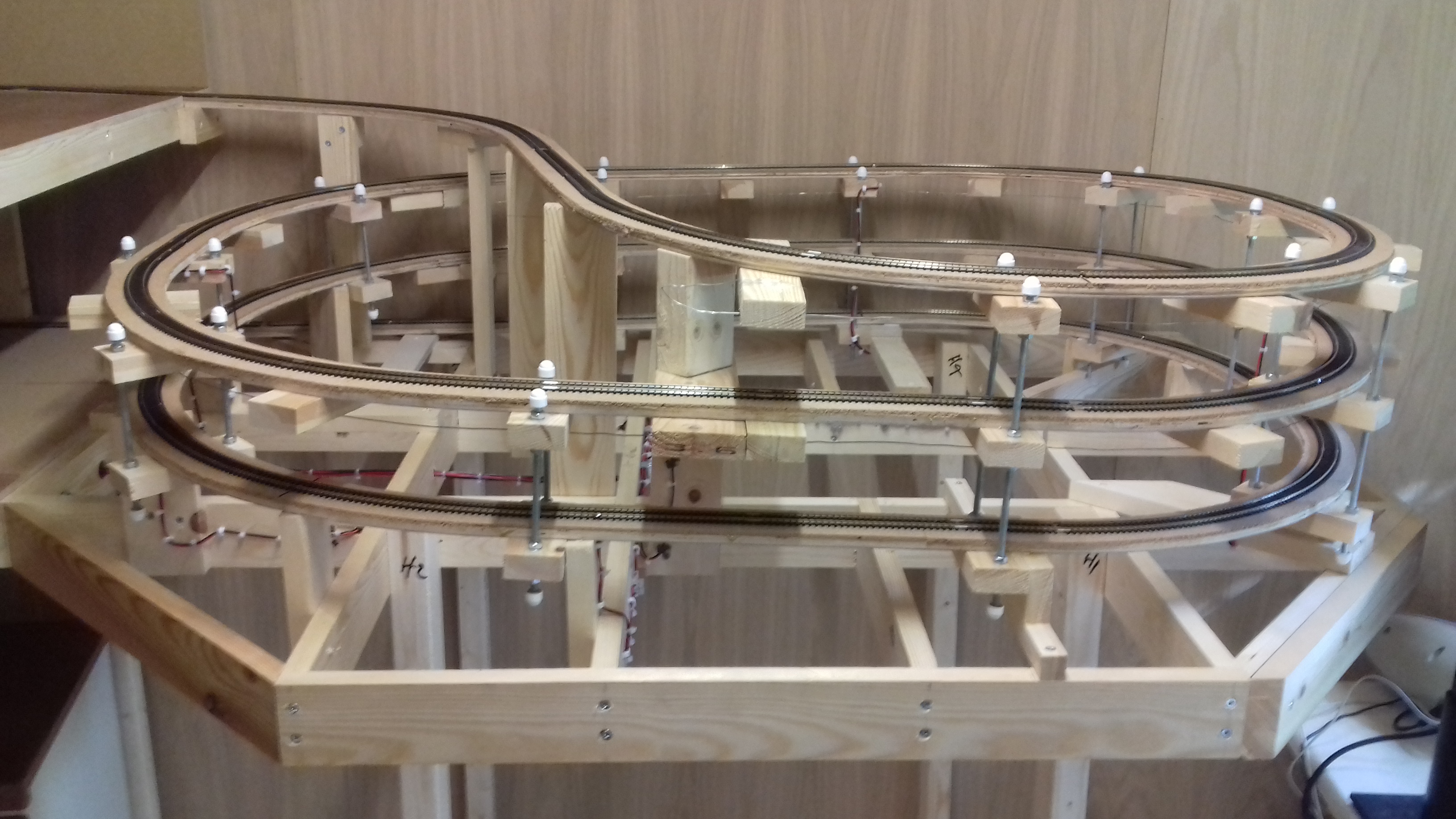
the opposite direction. A spiral can accommodate several tracks and in the case
of the image shown, this twin track spiral has both an up and a down track to
access hidden siding loops. We offer to design and manufacture your spirals,
supplying them as a self assembly kit, or we offer a full installation service.
Our spirals are fully adjustable allowing fine adjustment of each layer.
|

|
|
HIGH LEVEL TRACK BEDS AND GRADIENTS
Many model railways begin with a simple traditional flat baseboard and
develop gradients and levels as a later addition. Professional Layout Services
offer a manufacturing service for high levels and gradients as shown in the
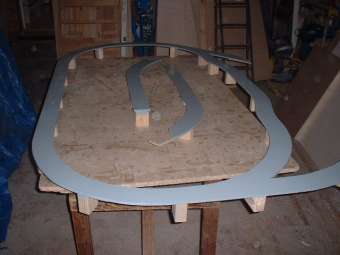
images below. The top left image shows the plywood track bed with risers to 75mm to
give clearance to the base/datum level track. The plywood shape is designed
using CAD software to ensure the machined shape matches the track plan. The top right image shows the finished high level section with the gradient sections in
the centre. Below can be seen another example of how to add a high level to
a flat baseboard..
TRAVERSERS
Traversers
operate like a sliding shelf and are usually used on small end to end layouts to
allow for the selection of trains and locomotives in the minimum space. It is
however possible to manufacture traversers as sliding fiddle yards to allow the
selection of full trains. Traversers are an alternative to forming terminus
sidings using turnouts which take up a great deal of space. The two upper images
are of a large 50 inch long traverser with eight tracks each electrically
switched from the main layout board. The traverser uses five flat mounted ball
bearing heavy duty draw runners to slide and support the traverser weight. The
lower image shows a 28 inch traverser used on a small end to end layout
with two end mounted heavy duty ball bearing draw runners. To create three twenty eight
inch sidings using turnouts would increase the layout length by at least twelve
inches even when using a space saving three way turnout. When space is at a
premium a traverser could make the difference!
CARRIER FRAMES
Where a large single board layout needs to be moved around, or where a
specific board may need to be moved for access we make a carrier frame on
castors. Ideal for use in garages and large sheds, or on small children's layouts
in a room for cleaning.
 |
 |
We are please to estimate on any model railway joinery that you may require.
Please contact us to discuss your requirements.
BACK SCENE BOARDS
A useful addition when having baseboards constructed is to have back scene
boards supplied. These can be machined to your required height based upon
commercial back scene papers, or to any chosen height. MDF is usually selected
as this provides a smooth flat surface to apply back scene papers. The images
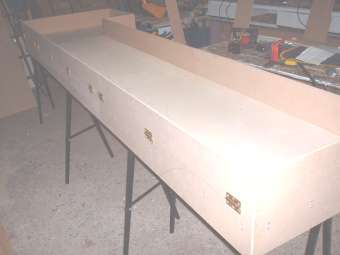
below show a bespoke commission to supply baseboards with back scene boards to
the rear and side of the three baseboards with a folding front board across the
front. The folding board hen dropped down provides a 'lip' of approximately 25mm
to stop anything falling off the board. When folded up the front is the same
height as the back scene boards for covering when not in use or in storage.
 |
 |
DIORAMA BOARDS
Small baseboards can be supplied as diorama boards ready fitted as required.
For example the images below show back scene boards fitted to a small baseboard
together with the cutting out for a turntable.
FOLDING BASEBOARDS
Often where space is limited for a model railway the only solution may be to
have a baseboard that folds. The images below show a simple 72" x 48"
baseboard manufactured from two boards each 72" x 24" designed to fold
allowing 12" clearance between the baseboards for scenery. It is always
necessary to lift the hinge above the baseboard level to allow the boards to
fold without crushing any track passing over the mid join. It should be noted
that if this baseboard option is chosen care is needed with the track laying at
the baseboard join to maintain alignment, and it may be necessary to have a
cable connection between the boards.
 |
 |
CONTROL PANEL DRAWS
Control panels and control apparatus can be expensive items
particularly digital master controllers. Where possible these should be
protected from damage and dust. One solution is to manufacture a sliding draw
under the main layout which uses extending draw runners to allow the control
apparatus to pull fully out from beneath the layout when operating the layout or
when not in use it can be pushed back protected under the layout. The images
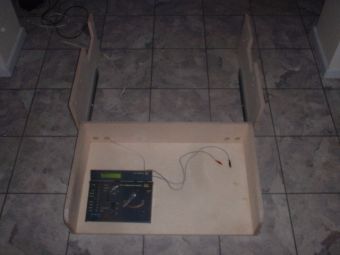
below show a large draw designed to hold two ZTC511 controllers (one a master
the other a slave) plus extra space at the back for an O gauge rolling road
which doubles as a program track. The images show the draw under construction
and during installation.
We are please to estimate on any model railway joinery that you may require.
Please contact us to discuss your requirements.
LIFTING SECTIONS
Most British model railway layouts are designed around the perimeter of the
available space with an operating well in the centre. Access to this operating
area is usually via a 'duck-under' which for many people is not possible due to
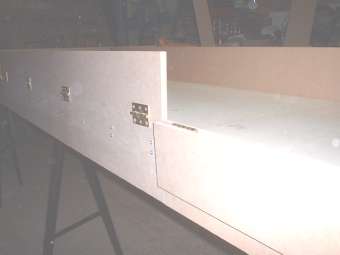
age or infirmity. A simple solution is a lifting section of baseboard or 'flap'
as shown in the image below which is designed to allow wheel chair access.
 |
 |
Lifting baseboard sections only work if the lifting hinge is raised above the
level of the track fixed to the baseboard. If the hinge is located at the
baseboard level the track on each side of the join will be crushed when the
section is lifted. It is only necessary to lift the hinge by around 9mm to allow
the lifting section function correctly. The fixed baseboard receiving the flap
needs a lip to catch the flap and prevent the flap falling through the gap. Gate
bolts are used at this end to maintain the track alignment. Not shown in these
images is the difference in length between the baseboard frame and surface on
the lifting section. To allow the section to lift the baseboard must overlap the
frame by approximately 12mm at the receiving end otherwise the frame will catch
and the flap will not open. If possible design
your track plan to have the minimum track crossing a flap and if possible keep
the track straight on the flap. A cable loop under the baseboard at the hinge
end will be needed to pass the track power to the flap. See the track sections
for hints and tips on maintaining track alignment at baseboard joins.
|