Insulfrog, Electrofrog and Livefrog Explanations!
A turnout may be described as a Point or Switch.
This section is not intended for anyone wishing to construct turnouts from
components or kits, it is intended to explain the terminology of a turnout with
particular reference to all track supplied by Peco . It will also explain the difference
between Peco Insulfrog and Electrofrog turnouts and how to alter the Peco
Electrofrog turnouts to Livefrog turnouts and the benefit of doing so. The
following image shows the basic terminology that will be used to describe a Peco
turnout. The image after the descriptions shows the frog area of the
turnout in more detail and shows the components not described on the image below.
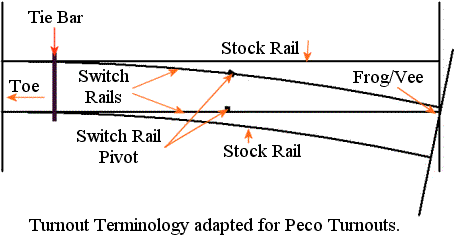
Turnout Terminology - some essential information is contained
within these definitions:
-
Toe - The description of the shape of a turnout is taken
from a foot. The toe end being the single road input into the turnout, and
the heel the exit route which can be either two or three road if a standard
or three way turnout. The assumed place
for track feeds is from the 'toe end'. The toe end we have two stock rails -
the two fixed rails that extend the full length of the turnout.
-
Stock Rails - The outer continuous fixed rails extending
from the toe to the heel. On Peco turnouts they have a machined rebate in
the upper profile of the rail to allow the switch rails to locate tightly
onto the stock rail.
-
Tie Bar - The moving bar attached to the switch rails which moves from side
to side when the turnout is operated by hand or mechanical means. On a Peco
turnout the tie bar is plastic and is controlled by an over centre spring to
lock the tie bar against the stock rail for running and electrical
continuity. The tie bar has a central hole and two outer spigots to
allow alternate connection of a turnout motor. The switch rails attach on
more recent turnouts with a tab on the base of the switch rail locating into
a slot on the tie bar. On older Peco turnouts the switch rails attached via
a small wrap round metal plate.
-
Switch rails - The moving rails that switch the direction of
the train using the tie bar and the switch rail pivot. The switch rails
taper towards the toe end to form a 'blade' allowing them to fit tight
against the stock rail into a machined rebate. When a switch rail is not in
use a gap is present between the switch rail and the stock rail to allow a
wheel to pass through. On both insulfrog and electrofog Peco turnouts the
switch rails also act as an electrical switch. The contact between the
switch rail and the stock rail is essential to pass the power through the
frog. If any dirt or obstruction accumulates on the back of the switch rail
blade or in the stock rail rebate, the running quality and electrical
continuity will be reduced. This may be why you have to push the tie bar
when a locomotive stops on a turnout.
-
Switch Rail Pivot - Located at the end of the switch rail
before the fixed closure rail extends to the frog/vee via the acute crossing
(closure rail and acute crossing not shown on the above diagram for clarity
but shown on the image below). The pivot allows a slight rotation of the switch
rail as the tie bar moves the switch rail.
-
Frog/Vee - As the switch rails extend towards the exit route
of the turnout they become diverging closure rails. One route has to cross
the other via the acute crossing which features a small gap to allow a wheel
to pass through. Once this gap is crossed the frog or vee is found allowing
the final divergence of routes.
-
Check Rails/Wing Rails - Not shown on the above diagram for
clarity but shown on the image below, the check rail pulls the wheel towards
the stock rail ensuring the correct road is taken and preventing
derailments. The check rail location is critical as it has to pull the wheel
before the acute crossing is reached as the gap in the rails at this
position is sufficiently large enough to allow the wheel to drift either
side of the frog/vee. The wing rails work with the check rails once the
wheel has passed through the acute crossing to ensure the correct road is
taken.

Insulfrog/Electrofrog Comparison
The following image shows the frog area of both an insulfrog and
electrofrog Peco turnout. They are easy to tell apart by looking at the acute
crossing and frog/vee. The insulfrog turnout has plastic sections in both the
acute crossing and frog making the two frog rails that form the V electrically
insulated, as compared to the electrofrog which is all metal and therefore the
two frog rails are not insulated. The continuous metal on the electrofrog
turnouts makes it much more reliable in operation as the locomotive wheel used
to collect the power from the track rarely looses contact with a conductive rail
ensuring high quality running.

If you are still unsure turn the item over and look at the wiring on the
underside of the frog. The insulfrog turnout will have the wiring crossing over
from just before the acute crossing to the frog rail as shown in the diagram
below, or on modern turnouts the crossing does not occur but the wires are separately
routed to and from the same places to effect a crossover bridge. Electrofrog
turnouts have one continuous wire between the closure rails and the frog. This
may be as illustrated in the diagram, or as an extended 'U'.

To appreciate the benefits of electrofrog turnouts it is
important to understand how both the insulfrog and electrofrog turnouts work
electrically.
INSULFROG
This insulfrog description also applies to Peco and Hornby Setrack turnouts
as they are unavailable as electrofrog. With power fed from the toe end the
stock rails will always remain live. With the switch rail in contact with the
stock rail the closure rail becomes live and using the 'crossover bridge' the
correct frog rail is powered. As the frog rails are insulated, only one side of
the V will be powered. Where the switch rail is not in contact with the stock
rail no power will be present and therefore one rail of the V will always be
electrically switched off allowing a locomotive to stand on this track as it
electrically off. Hence the tie bar acts as an electrical switch using the
switch rail to pick up the power from one of the stock rails. This is also why
the back of the switch rail blade and the stock rail get dirty as they suffer a
small electrical arc each time the turnout changes which causes a small dirt
spot to develop.

ELECTROFROG
Again assuming power has been applied from the toe end, the
electrofrog turnout works the same as the insulfrog turnout with the switch rail
collecting the power from the stock rail but this is where the similarity ends.
Once the switch rail is live, it passes the power to the closure rail
which is bonded to the V and opposing closure rail making all rails live to one
polarity except the opposing stock rail. The image below shows the electrical
working of an electrofrog turnout in both positions. The diagram also
illustrates two possible issues with electrofrog turnouts:
-
The frog rails change electrical state as the turnout
changes from straight to branch. If these rails are not protected by
insulated (plastic) rail joiners/fishplates it is likely they will cause a
short circuit.
-
If metal stock wheels are not accurate it is possible they
may cause a short circuit as they pass through the toe end of the turnout as
trailing unused switch rail is close to the opposing polarity stock rail.
This can be a particular problem on DCC layouts as a short circuit may cause
the unit to overload or cause 'run offs'.

LIVEFROG - Why alter a brand new turnout?
Peco electrofrog turnouts can be altered to work in a similar
manner to a hand made turnout achieving the best possible running for a little
extra effort. The alterations required are shown below:
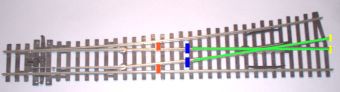
What are the benefits of this alteration?
-
By soldering the stock rail to its respective closure rail
(and cutting the closure rail nearer the acute crossing) we have created a
safe permanent link between the two rails removing the reliance upon the
contact between the switch rail and stock rail for electrical continuity. As
the stock rail and switch rail now share the same electrical polarity, dirt
in the stock rail rebate or on the back of the switch rail blade make no
difference to the turnout operation and no more electrical arc. The familiar
requirement to push the tie bar particularly on older turnouts as the over
centre spring deteriorates disappears. How many times have you seen that at
exhibitions?
-
We now have adjacent switch rails and stock rails
permanently of the same polarity. No chance of a short circuit on DC or DCC
layouts
The diagram below shows the operation of the new livefrog
turnout when working with an electrical switch to change the frog polarity as
the tie bar moves. The two detailed benefits above are clearly illustrated.

How do we switch the frog polarity?
Switching the frog polarity requires a simple SPDT (single
pole double throw) switch connected to the stock rails as
the inputs, and the frog as the output - a SPDT switch will always have three
contacts where two input contacts always switch to one output contact (or in
reverse one input can select two outputs). This can be a standard toggle switch
requiring the user to change the toggle switch after the tie bar has moved, or
automated into the movement of the tie bar by a microswitch, or more frequently
by a switch attached to the point motor e.g. Peco PL-13. The diagram below shows
this simple wiring. With the turnout set straight, the frog will polarise with
the polarity of the red stock rail - shown by the black link between the red
switch input and the green switch output. If you get it wrong (assuming you have
the correct output contact) just changeover the red and blue wires.

Is this extra effort worthwhile?
Without doubt! You will see a vast
improvement in the performance and reliability of your layout. It may be a
little complex but you will have the running quality of the better exhibition
layouts constructed with hand made track. Professional Layout Services will
always recommend you have this conversion completed where possible on layouts we
construct, or when we lay track for clients. Especially recommended for DCC
users!
GENERAL NOTE CONCERNING
SLIPS & CROSSINGS (DIAMONDS)
When planning a layout it is wise
to check the standard of your rolling stock wheels if you intend to use slips or
crossings particularly where finer scale track is to be used. If back to back
wheel measurements are not accurate, or if the wheel has a wide tread it may
cause short circuits on slips and crossings. This will be a problem with both DC
and DCC control.
SPECIAL NOTE FOR DCC USERS WITH PECO
ELECTROFROG SHORT OR LONG CROSSINGS (DIAMONDS) AND SCISSOR CROSSINGS.
All
electrofrog crossings need some form of polarity switching on the frog or V to
ensure the correct setting when a locomotive runs across. The scissors is
exactly the same as it has a crossing between four turnouts. In analogue use and
with some digital users a switch or relay is used to change the crossing frog
polarity. DCC users can simply install an auto reverse module to automatically
change the polarity as the locomotive enters the crossing. Ensure the crossing
is insulated correctly on the frog rails and if it connects to other turnouts as
required; then simply connect the
outer crossing stock rails to the DCC ring main together with the auto reverse
module inputs, then connect the module outputs to the crossing frogs - one to
each frog. No need for complex wiring, switches or relays!


