DCC DIGITAL
Professional Layout Services have been involved
in multi-train control for many years. We gained much experience of the
early 'digital' systems form Hornby (Zero 1), H&M and Airfix MTC. We also
attended the early Marklin Digital seminars held in the late 1980's. As the NMRA
DCC code emerged we allied with the British manufacturer ZTC Controls. However as the DCC scene developed we expanded our DCC horizons working with
most
systems over the years including MRC, Lenz, Digitrax, EasyDCC, NCE, ECOS, Fleischmann, Bachmann,
Hornby and Gaugemaster to name but a few. We have been constructing DCC
model railways since 1996 with most of our manufacturing time dedicated to
DCC.
Why buy out of date technology - would you buy a Betamax VCR?
Model railways have been controlled using conventional DC (Analogue)
control for over fifty years. Conventional DC or analogue control
relies upon the locomotives responding to the power applied to the
track by the controller - You are driving the track not the
locomotive! Analogue operation becomes restrictive as on one section of track we can
only independently control one locomotive. Prototypical locomotive
movements become almost impossible without many section breaks and the
accompanying switches and cable. DCC Digital changes all this by
locating the controller in the locomotive - the decoder or
'chip' as it may be known.
Control the locomotives not the track!
Digital Command Control (DCC) is the method of running a model railway by
controlling the locomotives rather than the track. It is possible to run more
than one locomotive on the same length of track in a different direction and at
a differing speed without any other locomotive responding to the control signal.
This is achieved by locating a decoder in the locomotive that listens to
information in the track. If the information relates to that particular decoder,
it obeys the instructions contained within. Certain locomotive decoders allow
functions on the locomotives to be controlled if available e.g. lights, un-couplers
etc. The development of sound decoders has added a new dimension to model
railways with actual digital locomotive sound recordings playing through a micro
speaker housed in the locomotive.
With DCC control the track is permanently live as the locomotives are not
controlled by the track. It is therefore possible to control the layout using
two wires normally forming a ring main above or below the layout into which
connections are made to the track as required. Accessory decoders are also
available to control turnout motors, signals etc from the master controller.
Since the introduction of the NMRA code of practice, the problems experienced by
the early multi-train control systems have vanished. All manufactures producing
to the NMRA standards have to conform to a standard that allows the required
degree of interaction between systems.
So if you're not yet convinced - what are the advantages over conventional DC
control!
 | The main advantage of DCC control is that you control the locomotives not
the track therefore allowing prototypical train movements. |
| Once a master controller has been purchased, most systems allow for the
simple addition of controllers as required. No complicated switching is
needed to use the new controller. Once installed it works as the master
controller but usually without the facility to program. |
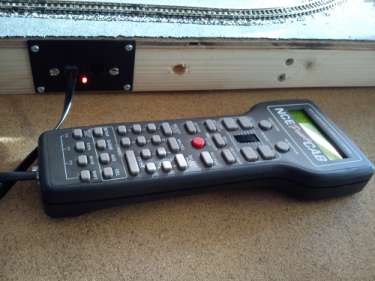
| Radio control of your model railway is possible with the operator no
longer restricted by a desk top or corded controller. Access to all
locomotive decoder functions is possible together with controlling
accessories e.g. turnout motors also from the radio control handset.
Operation can be remote from the layout or the user can follow train
movements around the layout without the worry of cables. |
| On large layouts in standard DC control a power loss may take place due to
the size of the layout. Using booster units a DCC digital layout cannot run out
of power as 'power districts' can be created using a booster unit with its
own power supply. The booster unit takes the digital signal data from the
master unit and adds the new power supply ensuring stability across the
layout. Accessories e.g. turnout motors can be supplied from a booster unit
making their operation independent to the track. |
| Accessories such as turnout motors and signals can be controlled from
accessory decoders. These decoders are programmed similar to locomotive
decoders giving the turnout or signal an individual address that can be
called from the master control unit. Both solenoid and slow action motors
can be controlled in this way. Signals and other accessories can also be
controlled using accessory decoders. |
| Routes, Presets or Macros can be set up to allow simple route selection through
turnouts. Depending on the system the pressing of one button can result in
up to eight or more turnout motors changing. On larger system up to 256
routes can be programmed each with up to 256 accessory operations! This is
one of the huge advantages of DCC turnout motor control that is often
overlooked. |
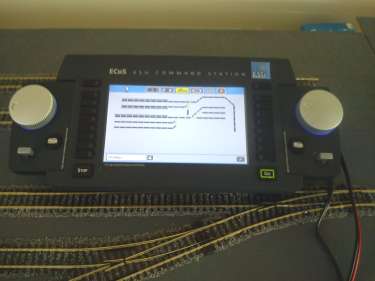
| More advanced DCC systems have a screen display allowing the selection of
locomotives and accessories from this screen rather than a keypad. Some
systems e.g. ECos ESU has a track compiler allowing layout plans to be
schematically represented and turnouts opeated from the touch screen |
| Integrated control panels can be constructed to offer multiple options for
the control turnouts. An analogue style schematic control panel or lever
switches can be integrated into your DCC system to operate turnouts without
loosing the facility to control individual turnouts via your DCC handset or
multiple turnouts via routes presets or macros. |
| Reverse loops on analogue layouts need special attention with some form of
double pole changeover switch to reverse polarity. Most DCC systems offer
modules to automatically switch the polarity once a locomotive enters the
block. Some turntables need to have the polarity switched once they have
passed through 180o, again this module offers automatic
switching. |
| Computer control has been a goal for many enthusiasts. Under analogue
control this is highly complex with few commercial products available. Most
DCC systems offer a USB connection to an interface allowing the use of either Open Source software or the purchase of
commercial software to control your layout. |
| Sound decoders add that extra dimension to a layout. |
| DCC is evolving continually. More will be added to DCC model railways. We
never stop learning! |